
Good cholesterol does miracles for your circulation—yet the details matter, and they’re not magic. You support reverse cholesterol transport, moving excess cholesterol from macrophages and arterial walls to the liver for excretion. This reduces foam cell formation, local inflammation, and keeps endothelial function robust. With that, nitric oxide signaling and laminar flow stay steady, preserving arterial compliance. Keep an eye on how lifestyle and lipid quality shape these processes, because small changes can sustain perfusion you rely on.
Key Points
- HDL supports reverse cholesterol transport, removing excess cholesterol from arteries and reducing foam cell formation that can disrupt flow.
- HDL preserves endothelial nitric oxide signaling, promoting vasodilation and steady laminar flow.
- Efficient lipid transport with HDL limits lipid deposits, maintaining arterial compliance and smooth circulation.
- HDL quality reflects antioxidant support and exercise/diet effects that enhance vascular resilience and perfusion.
- HDL works with inflammation control and other risk factors, contributing to reliable flow and tissue perfusion rather than a standalone predictor.
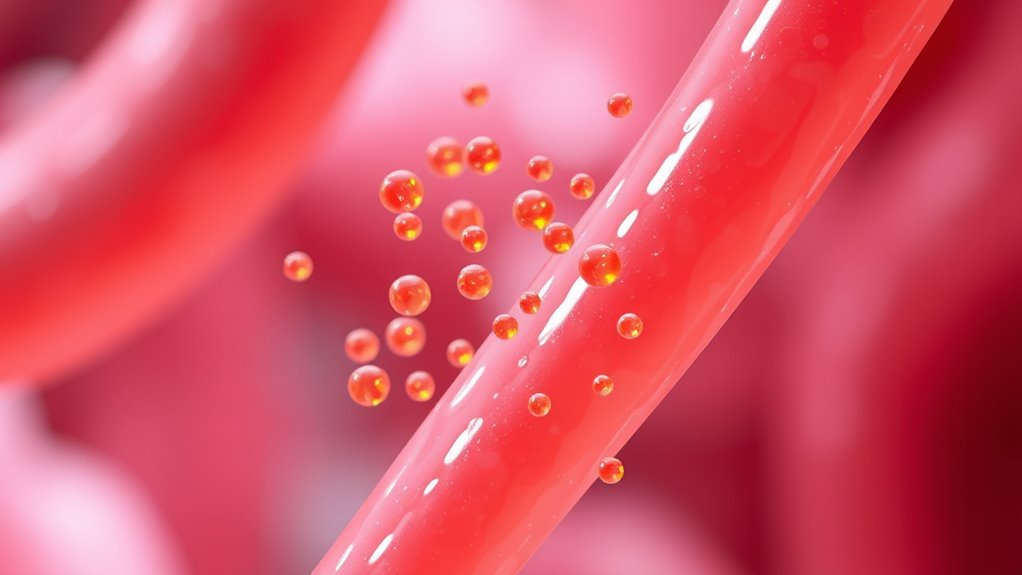
Cholesterol and Circulation are tightly linked, shaping how blood vessels carry lipids and deliver essential nutrients while influencing cardiovascular risk. When you consider good cholesterol, you’re focusing on high-density lipoprotein (HDL) function, reverse cholesterol transport, and the way HDL interacts with the endothelium to support steady flow. You’re not chasing a single number; you’re evaluating a system where lipid carriers, vascular tone, and inflammatory status converge to determine arterial health. In practical terms, you’re looking at how cholesterol transport pathways limit lipid deposition, promote endothelial resilience, and preserve microvascular perfusion. Evidence shows that efficient HDL-mediated cholesterol efflux from foam cells reduces plaque progression, while preserving nitric oxide signaling helps maintain vasodilation and blood flow. You can translate this to day-to-day decisions, emphasizing lifestyle patterns that support HDL quality, not merely quantity.
Good cholesterol = HDL function, endothelial resilience, and steady flow through efficient reverse transport.
You’ll appreciate that good cholesterol isn’t just a static measure—it’s a functional asset within circulation. Your arterial health benefits when HDL particles efficiently accept cholesterol from peripheral cells and macrophages, then deliver it to the liver for excretion. This reverse cholesterol transport curbs lipid overload in the arterial wall, mitigating foam cell formation and inflammatory triggers that threaten laminar flow. In practice, you’re reinforcing this pathway through sustained physical activity, weight management, and dietary choices that enhance HDL functionality rather than simply elevating its plasma concentration. The result is smoother circulation, with fewer perturbations in shear stress and less endothelial dysfunction to contend with.
From a mechanistic stance, you recognize that cholesterol transport involves apolipoproteins, lipid core composition, and receptor-mediated uptake. The integrity of this system matters because disrupted transport can leave arteries exposed to lipid-rich deposits, compromising arterial compliance and flow reserve. You’re informed by trials and meta-analyses showing that environments which promote HDL quality—antioxidant-rich foods, reduced saturated fat intake, and regular aerobic exercise—are associated with better arterial health markers and lower residual cardiovascular risk. While you monitor total cholesterol, the emphasis remains on the functional capacity of HDL to mobilize cholesterol and sustain smooth circulation under varying physiologic demands.
In clinical framing, you acknowledge that good cholesterol complements other risk modifiers rather than acting solo. You’re guided by evidence that arterial health arises from integrated lipid handling, endothelial function, and inflammatory milieu. Practical emphasis falls on consistent activity, dietary patterns that support lipid transport efficiency, and situational risk reduction. You’re not chasing perfection; you’re pursuing reliability of flow, resilience of vessels, and predictable tissue perfusion. When you optimize cholesterol transport, you reinforce arterial health, support stable blood movement, and reduce the likelihood of flow-limiting plaques. That’s how good cholesterol helps maintain smooth circulation, day after day.
Common Questions
How Does HDL Specifically Remove Plaque From Arteries?
HDL helps remove plaque through HDL mechanisms that promote reverse cholesterol transport. You enable macrophages to efflux cholesterol onto HDL particles, which then transport it to the liver for excretion, reducing lipid buildup. This Plaque clearance process also involves anti-inflammatory and endothelial-stabilizing actions, improving arteriolar function. In essence, HDL participates in mobilizing cholesterol from arterial walls and guiding it out of circulation, contributing to smoother flow and reduced atherogenesis.
Can High HDL Completely Prevent Heart Disease?
First, no, high HDL can’t completely prevent heart disease. You’re told that while HDL helps reverse cholesterol transport and dampen inflammation, risks like LDL levels, blood pressure, diabetes, and smoking still matter. Think of a two word idea, two word idea—“balance persists.” In your daily life, you maintain evidence-based strategies: exercise, dietary fiber, and medications when indicated, to lower risk. You’ll monitor lipids, follow clinician guidance, and understand HDL’s benefits aren’t a guarantee.
Do Activities Like Exercise Increase HDL Quickly?
Exercise can raise HDL, but the boost isn’t instant. You’ll usually see gradual improvements over weeks to months with regular activity. The quick HDL boost tends to be modest, and results vary by genetics, weight, and baseline fitness. For meaningful changes, combine aerobic and resistance training, aim for consistent sessions, and pair with a healthy diet. In short, exercise benefits HDL over time; don’t expect a dramatic immediate spike.
Do All Fats Equally Raise HDL Levels?
No. Not all fats raise HDL equally. You’ll find better HDL effects from monounsaturated fats and some polyunsaturated fats, while trans fats can hurt HDL and overall lipids. Your fat types matter, but the HDL function also depends on overall diet, activity, and genetics. Aim for balanced fat intake, prioritize olive oil, nuts, fatty fish, and fiber. Evidence-based patterns show modest HDL gains with targeted fat types, alongside cardio.
Is HDL Protective in All Age Groups?
HDL is not uniformly protective across all ages. While HDL function supports reverse cholesterol transport and endothelial health, age-specific protection varies: younger individuals often show stronger anti-inflammatory benefits, whereas older adults may experience diminished HDL functionality. You should recognize that HDL’s protective effects depend on particle quality, context, and comorbidities. In practice, focus on lifestyle and risk-factor management, noting HDL function contributes to vascular integrity rather than serving as a universal shield across every age group.