
Take this real-world idea: when your arteries are healthy, your muscles receive a steady stream of oxygen and nutrients even as your pace changes. In practical terms, compliant vessels blur pulsatile stress and preserve capillary perfusion, supporting steady mitochondrial fuel use at rest and during activity. Endothelial signaling and intact mechanics reduce perfusion mismatches that raise effort and slow recovery. The result is smoother energy delivery, but there’s more to consider as you optimize vascular function.
Key Points
- Healthy arteries preserve stable, pulsatile flow, reducing pressure spikes that disrupt microvascular perfusion and energy delivery to tissues.
- Endothelial health supports consistent substrate transport (oxygen, glucose, fatty acids) to mitochondria, boosting energy production.
- Arterial compliance smooths blood flow, maintaining oxygen and nutrient supply during rest and activity.
- Reduced vascular inflammation and improved perfusion enhance endurance, recovery, and mood stability.
- Monitoring vascular health (PWV, endothelial function) guides lifestyle or therapy that optimizes energy delivery.
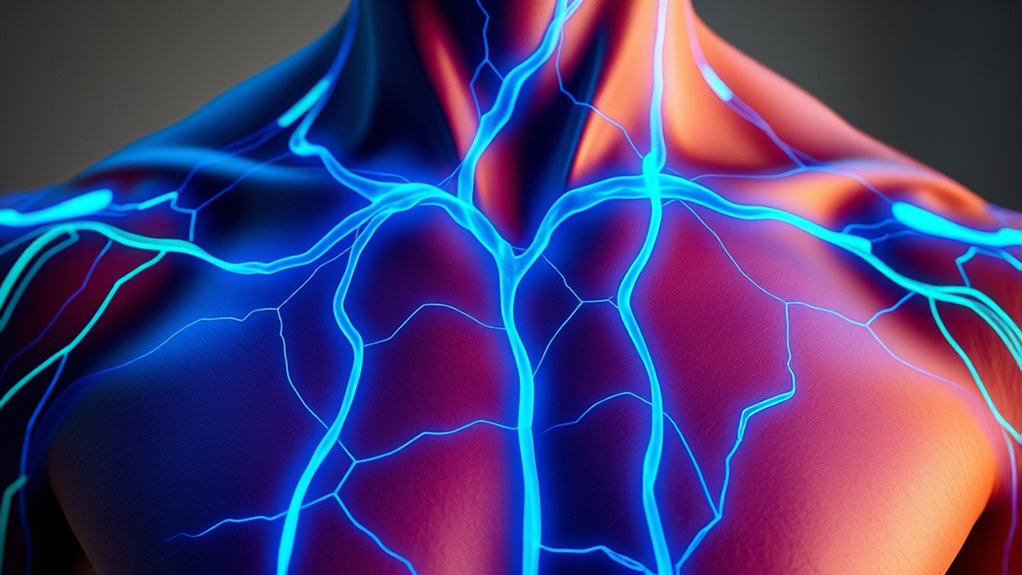
Healthy arteries are essential for efficient energy delivery throughout the body. When you examine arterial health in a clinical frame, you recognize that intact vessels enable capillary perfusion to match cellular demand. You’ll notice that healthy circulation supports steady energy delivery to muscles, organs, and the brain, reducing localized fatigue and improving functional performance. In this context, the vascular system functions as a conduit that translates metabolic opportunities into usable energy, rather than as a passive channel. You’re encouraged to assess how arterial compliance, favorable shear stress, and intact endothelial signaling contribute to predictable energy flux across tissues.
Examining the mechanics, you understand that pulsatile flow delivered by compliant arteries mitigates pressure spikes that could disrupt microvascular beds. This stability supports mitochondria by maintaining substrate availability and oxygen delivery, which are essential for metabolism optimization. When arterial health is preserved, you experience fewer transient energy dips, because blood can swiftly adapt to changing demands during tasks such as lifting, walking, or cognitive effort. You appreciate that disruptions—whether from atherosclerotic burden, inflammation, or hypertension—can impair perfusion and create mismatches between energy supply and demand. In clinical observations, these mismatches correlate with reduced endurance, slower recovery, and greater perceived exertion.
You recognize that metabolic efficiency hinges on continuous substrate delivery. Glucose, fatty acids, and oxygen must reach mitochondria efficiently, and arterial integrity facilitates this delivery. In practice, you’ll see that healthy circulation supports stable resting metabolism and preserves the capacity for rapid metabolic acceleration during activity. This relationship emphasizes that lifestyle and risk factor management, including blood pressure control, lipid optimization, and glycemic regulation, have direct implications for energy production at the cellular level. You’re advised to monitor indicators such as pulse wave velocity and endothelial function as surrogates for arterial health, since improvements in these measures often align with better energy delivery and mood stability.
From a preventive standpoint, maintaining arterial health supports long-term metabolic resilience. You can translate this into daily choices that modulate vascular tone and inflammatory burden, promoting sustained energy availability. For metabolism optimization, the focus remains on consistent aerobic activity, nutrient timing that respects substrate availability, and strategies that reduce vascular oxidative stress. You’re equipped to interpret interventions—physical activity, dietary patterns, and pharmacologic agents—in terms of their vascular benefits and downstream effects on energy delivery. In sum, your arterial health directly shapes the efficiency of energy transfer, the steadiness of metabolism, and the reliability of physical and cognitive performance across daily life. Healthy circulation thus underpins robust energy flow, with clearer links between vascular status and functional capacity than often acknowledged.
Common Questions
Do Antioxidants Directly Enlarge Artery Diameter?
The answer: no, antioxidants don’t directly enlarge artery diameter. Imagine your arteries as a garden hose; antioxidants protect the lining, reducing inflammation and oxidative stress that can narrow vessels over time, but widening happens via long-term vascular health factors. In evidence terms, the antioxidant effect supports function, not immediate structural dilation. You might see improved flow indirectly, yet “artery diameter” changes aren’t a direct, acute antioxidant consequence.
Can Exercise Alone Overhaul Energy Circulation Quickly?
Exercise alone can rapidly improve energy circulation somewhat, but it won’t overhaul it quickly for everyone. You’ll benefit from consistent activity that enhances microcirculation dynamics and supports hormonal balance, yet gains vary by fitness, health, and underlying vascular status. Evidence shows aerobic conditioning improves blood flow and endothelial function, while resistance work aids peripheral circulation. For lasting changes, pair exercise with sleep, nutrition, and stress management to optimize hormonal balance and microcirculation dynamics over time.
Do Arteries Affect Brain Energy Beyond Heart Health?
About 20-25% of your brain’s energy use links to arterial signals that reflect overall vascular health. Yes, arteries affect brain energy beyond heart health. You rely on crisp cerebral perfusion to sustain neurons and signaling. When arterial signals are robust, brain energy delivery improves, supporting attention and processing. You should monitor blood pressure, lipid profiles, and inflammatory markers, since these influence arterial tone and flow, directly impacting cognitive efficiency and neural metabolism.
Is Arterial Health Tied to Mental Clarity or Mood?
Yes, arterial wellness is linked to mental clarity and mood. You may experience improved cognitive energy when arterial health supports consistent cerebral blood flow, reducing fluctuations in perfusion that affect attention and processing speed. Evidence suggests a mood connection via vascular regulation and inflammatory markers. Maintain arterial wellness through blood pressure control, lipid management, and physical activity to support cognitive energy and overall mental performance. In short, arterial wellness supports mental clarity and mood.
What Lifestyle Harms Arterial Energy the Most?
Severe consequences meet simple choices: high sodium intake and chronic stress harm arterial energy the most. You’ll spike blood pressure, increase endothelial strain, and reduce nitric oxide availability, draining energy delivery to tissues. You may feel fatigue, headaches, or mood swings as your vessels tense. Prioritize stress management, limit salt, and pursue exercise, hydration, and balanced meals. The evidence links modifiable habits to better arterial function and steadier energy flow.